

Your Cortisol Is Changing Your Brain. Here's What to Do.
Not stress as a mood problem. Not burnout as a productivity issue. Chronic cortisol as a measurable threat to your brain.

In April 2025, the Framingham Heart Study published findings in the journal Alzheimer's & Dementia that stopped a lot of women in their tracks. Researchers found that elevated cortisol levels in menopausal women are associated with structural brain changes linked to Alzheimer's risk.
I want to sit with that for a second before we get to the solutions. Because I think most of us have been told, in a hundred different ways, that stress is just part of life. That we're strong enough to handle it. That the solution is a bubble bath and a good night's sleep.
That is not what the research says.

I Lived This Before I Had the Words For It
Years before I read the Framingham data, my body was already writing the case study.
I am, by nature, a type-B person. I teach nervous system regulation. I have spent over a decade guiding women through breathwork, movement, and the slow, unglamorous work of coming back to their bodies. And yet, as perimenopause arrived, I could not get a handle on my own nervous system.
The irony was not lost on me.
What followed was a psoriasis flare that required months of light therapy to resolve. Not a minor inconvenience. Months. My body had been sending quieter signals for a long time and I had kept moving, kept managing, kept being the one who handles it. Eventually my nervous system stopped whispering and started screaming in the only language left: my skin.
That experience became the foundation of everything I now teach. Not because suffering is a credential, but because I understand viscerally what the research is now confirming: a nervous system running at full capacity, in a body navigating hormonal change, with no mechanism for completing the stress cycle, will find a way to get your attention.
The question is whether you respond before it has to escalate.
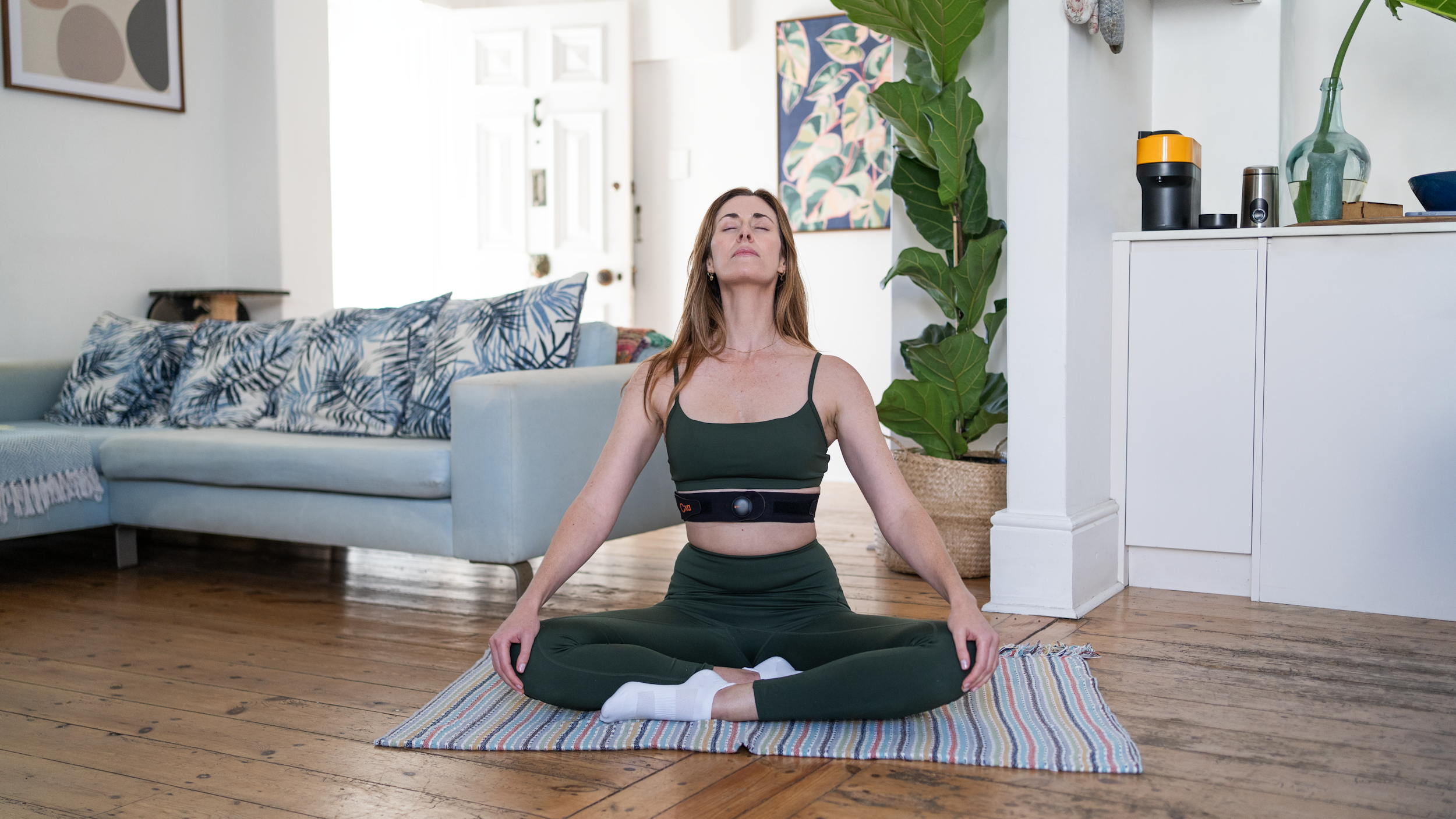
Why This Season Is Different — And Why Your Nervous System Was Not Built For It
Here is something I come back to again and again with the women I work with: your nervous system was designed for a tribe of roughly 150 people. That is the social load a human brain evolved to manage. The relationships, the responsibilities, the threats, the noise.
Now look at your actual life.
You are managing teenagers and aging parents simultaneously, which is not a metaphor for being busy — it is the literal definition of the sandwich generation. You are navigating a full-time career while holding the mental map of an entire household. You are absorbing the ambient noise of a social media feed designed by engineers whose job is to make sure you never fully exhale. You are doing this in a body where declining estrogen has raised your baseline cortisol, reduced your stress threshold, and made everything that was already hard feel harder.
You are not weak. You are overloaded. And the Framingham data tells us the stakes of staying overloaded are higher than most of us understood.
So. What do we actually do about it?

5 Nervous System Resets That Actually Work (Not Just 'Take a Bath')
These are not aspirational wellness habits. They are evidence-based interventions, each under five minutes, each free, each designed to work on a nervous system that is already depleted. Pick one. Do it today.
The Physiological Sigh
Two short inhales through the nose, followed by one long, slow exhale through the mouth. Five seconds. You can do it in a meeting, in the school pickup line, standing at the kitchen counter. This is the fastest evidence-based way to activate your parasympathetic nervous system. It works by deflating over-inflated alveoli in the lungs and triggering the vagal brake. Your body already does this involuntarily when you cry — that involuntary double-inhale before the sob. Now do it on purpose, before your body has to cry to get the relief.
Reframe the Threat, Not the Stressor
Chronic cortisol is not just about what stresses you. It is about your nervous system interpreting daily life as dangerous. When a stimulus arrives, try a single cognitive interrupt before the HPA axis fires: 'Is this actually a threat to my survival, or is it uncomfortable?' That is not toxic positivity. That is a literal neurological reroute. Uncomfortable and dangerous are not the same thing, and your body needs reminding.
Cold Water on Your Face or Wrists
This activates the dive reflex — a hardwired physiological response that drops heart rate and increases vagal tone. You do not need a cold plunge or an ice bath. Thirty seconds at the bathroom sink works. Simple, free, immediate.
Complete the Stress Cycle
This one is less intuitive but critically important. Your body needs a biological signal that the threat is over. Without that signal, cortisol stays elevated even after the stressor is gone. Movement (even a brisk 20-minute walk), crying, or vigorous trembling — yes, look up Tension and Trauma Releasing Exercises (TRE) — closes the loop. This is why you feel genuinely better after a hard workout or a good cry. That is not weakness. That is your nervous system doing exactly what it is supposed to do. Let it.
The Neural Wi-Fi Reset — Slow Eye Scan
Slowly move your gaze from left to right across the room without moving your head, then let it land softly on something in the distance. This activates the superior colliculus and signals to your threat-detection system that the environment is safe. It is a foundational element of somatic therapies — EMDR uses a structured version of this. It feels almost too simple, which is exactly the point. Your nervous system does not need complexity. It needs a clear signal that you are not in danger.

The Smallest Version That Still Works
I am not asking you to overhaul your morning routine. I am not adding to the pile. Pick one of these. Do it once today. Do it again tomorrow. That is the whole ask.
The Framingham study is not a reason to panic. It is a reason to stop treating nervous system regulation as optional. Not as a spa day. Not as a treat when you have time. As something that belongs in your day the same way sleep does, because the research is now telling us it protects your brain the same way.
You have been holding everything together for a long time. Your nervous system deserves the same attention you give everyone else.